
ONES TO WATCH IN SPACE TECH

ONES TO WATCH IN SPACE TECH
We’ve all seen them, the mind-bending Hollywood movies that capture our imaginations with visions of distant worlds and never-before-seen technology.
But some of the most exciting space stories are unfolding in real life.
As the global space economy gathers pace, a new generation of companies is pushing ahead with advances in satellites, spacecraft and launch technology, opening up new possibilities in unexplored orbits and here on Earth.
Here are five outrageously exciting space tech startups changing how we collect data, reach orbit and operate beyond our planet.
At Harpswood, we work with space tech and technology-led businesses and have successfully helped them grow their media presence. If you’re interested in finding out more complete this form and we’ll be in touch.
FIVE BUSINESSES SHAPING THE SPACE ECONOMY
1 // NEWORBIT
What if satellites could fly much closer to Earth?
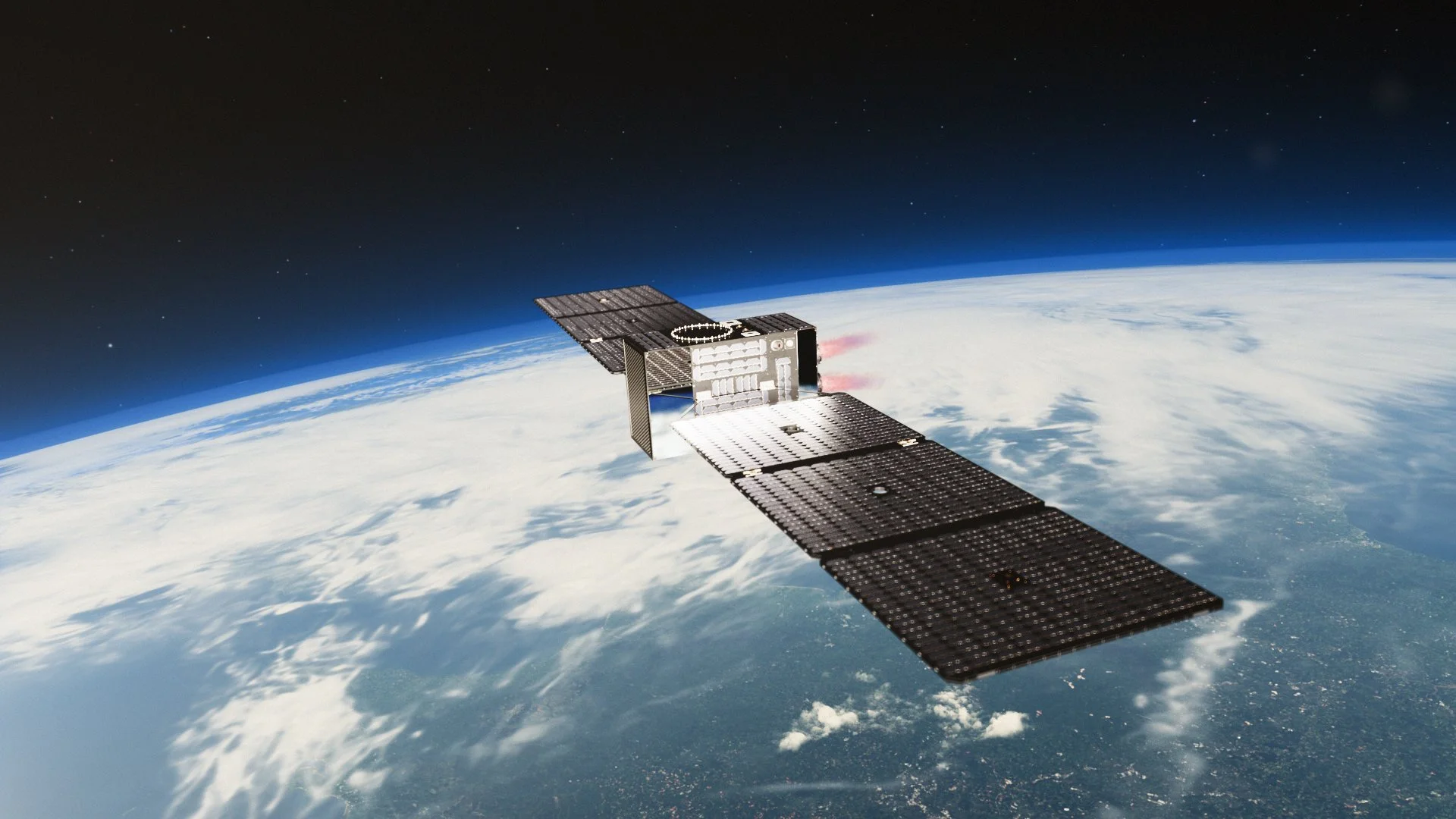
Reading-based NewOrbit is engineering Very Low Earth Orbit satellites that fly at one-third the altitude of conventional satellites, redefining what is possible with existing satellite technology.
Flying closer to Earth enables sharper images, stronger communication signals and faster connectivity without requiring larger or more complex spacecraft. NewOrbit is developing proprietary propulsion technology to counter the atmospheric drag that has historically made sustained operations at this altitude difficult.
Founded in 2021, NewOrbit has raised £21.6 million to date and plans to launch its first commercial satellite in 2028.
Read more about our work with NewOrbit here.
2 // SPACE FORGE
What if some of the world’s most advanced materials could be made more effectively in space?
Cardiff-based Space Forge is developing satellites that use the unique conditions found beyond Earth, including microgravity, vacuum and extreme temperatures, to manufacture high-performance materials.
Its technology focuses on materials used in semiconductors, quantum computing, clean energy and defence. The company is also developing a reusable heat shield that will allow these materials to be returned safely to Earth.
Space Forge launched its first manufacturing satellite, ForgeStar-1, in 2025. That year, it raised £22.6 million in what it described as the largest Series A secured by a UK space-tech company. The round was led by the NATO Innovation Fund, with backing from World Fund and the British Business Bank.
3 // THE EXPLORATION COMPANY
Deliveries to space stations currently depend on a small number of spacecraft. The Exploration Company wants to change that.
Founded in 2021, the company is developing Nyx, a family of reusable spacecraft designed to transport cargo to space stations and bring equipment safely back to Earth. Future versions are also being developed for missions around the Moon and, eventually, carrying people.
Nyx is designed to launch on several types of heavy rocket, dock with different space stations and fly again after returning to Earth. Future versions could also be refuelled in orbit, enabling longer and more ambitious missions.
Operating across Europe and expanding internationally, The Exploration Company has raised more than €230 million.
4 // SKYRORA
Satellites can only transform life on Earth if they can get into space in the first place.
Headquartered in Glasgow, Skyrora designs and manufactures rockets for small satellite launches. Its flagship Skyrora XL is a three-stage vehicle being developed to carry satellites into low Earth orbit from British soil.
The company operates manufacturing and testing facilities in Scotland and has developed much of its technology in-house, including rocket engines, 3D-printed components and Ecosene, a fuel made using waste plastic. In 2025, it became the first UK launch company to receive a licence to launch from the UK.
Its ambition is to give satellite companies more responsive access to orbit while strengthening the UK’s domestic launch capability.
5 // GALACTIV
Satellites are extremely expensive to build and launch. Galactiv wants to help operators keep them working for longer. In other words, it wants to be the RAC for space.
Based in Austin, Texas, Galactiv is developing an Active Space Servicer: a spacecraft designed to capture and assist satellites while they remain in orbit. Its proposed services include inspection, refuelling, repair, relocation and controlled de-orbiting.
Capture robotics allow the spacecraft to securely grasp other satellites without interrupting their operations. Designed to complete multiple missions and be refuelled itself, the servicer could extend the life of valuable spacecraft while reducing the amount of debris left in orbit.
LOOKING AHEAD
The SpaceX IPO was merely the start of an explosion in the space economy. From compressing satellite data and unlocking new orbits to reusable cargo vehicles and in-space servicing, startups are tackling the infrastructure needed to make space more accessible, efficient and sustainable.
Some are helping us get more from the satellites already above us. Others are rethinking how spacecraft are launched, maintained and returned to Earth. Together, they are building the foundations of a more capable space economy.